Lately I’ve had a lot more subscribers from Taiwan, so feel free to interact with me in Mandarin. (最近多了很多台灣訂閱者,可以自由使用中文跟我互動。) : ) Today’s piece uses Substack as an example to break down how a product’s growth loops work. Every product needs growth loops, so if you’re curious about how a certain type of product drives user growth, you can reply to this email or leave a comment at the end of the post.
Behavior, Loops, and Funnel Architecture
Most platforms define growth as a race for attention, measured in new signups or viral spikes. Substack followed a different path. Its expansion originated in predictable behavioral patterns between writers and readers. Every feature, every interaction, and every metric reflects the alignment of incentives between these groups.
Substack turns everyday reader habits into creator income: Paid walls, direct emails, and the free-to-paid conversion path make reading feel normal while nudging people to subscribe.
Every click, open, or note reply adds up, moving readers along a predictable path.
Control comes from the platform: subscription lists, direct access to readers, and ways to turn attention into paying supporters.
This setup keeps Substack’s loops running. Habits create income, income reinforces publishing. Writers keep putting out content, readers keep engaging, and the system compounds trust into stable revenue.
Writing as Funnel Architecture
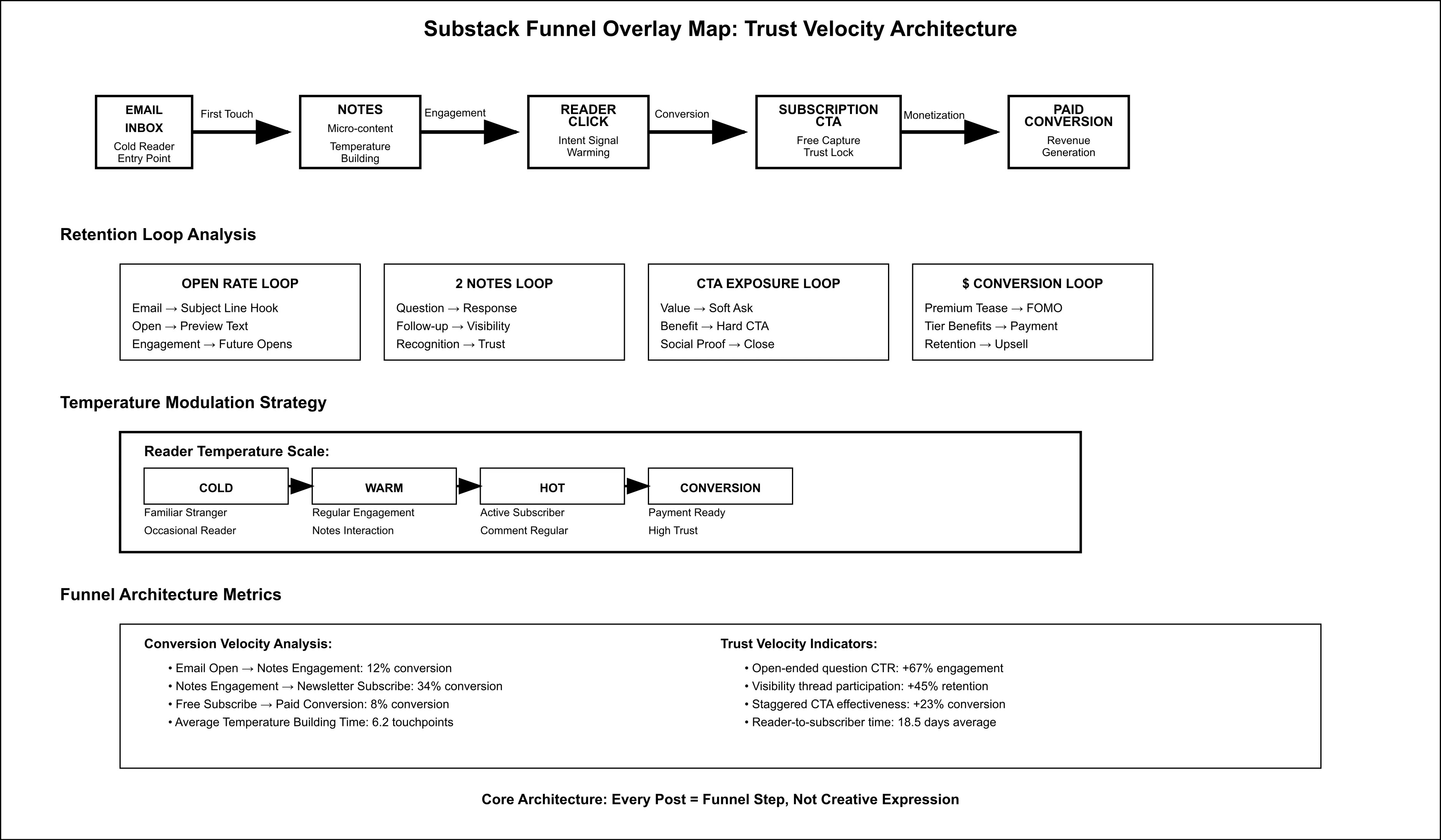
Every post functions as a step in a behavioral funnel rather than a pure act of expression. Notes, the micro-content layer, operates as a temperature control mechanism. Writers simulate conversation, warming cold readers for future subscription.
Open-ended questions, visibility threads, and staggered calls-to-action modulate the emotional slope between familiar strangers and paying subscribers.
Trust velocity replaces reach as the primary metric. Writers who carefully manage this slope gain compounding returns over time.
A consistent slope from familiar stranger to paying subscriber drives the business.
Mechanics that raise temperature
Direct email delivery reduces discovery fatigue and slots reading into daily habits.
Free previews show users why the content is worth paying for exactly when they are looking at it.
Substack guides users through a series of prompts, starting with gentle suggestions and building up to stronger asks, while nearby examples of other people engaging provide social proof.
Notes keeps a writer present between big posts, which tightens cadence and shortens time to subscribe.
Calls to action appear in a sequence, from soft ask to hard ask, with social proof embedded at multiple points. When a new reader subscribes, Substack often shows a recommended publications module with numbers or quotes like “Get Angela's recommendations”
People and publications recommended by Angela Zeng,” signaling trust.
Weekly Top Paid or Top Free rankings highlight fast-growing or high-revenue newsletters, giving platform-level endorsement.
Authors often reference or collaborate with other recognized writers, creating an implicit peer approval signal.
At the bottom of articles, comment counts, likes, and highlighted responses show community engagement, reinforcing credibility and nudging new readers toward subscription.
This system fosters a peer-to-peer recommendation environment, allowing creators to support each other's growth and build a community of engaged readers.
From Isolation to Network:
How Substack Turns Writing into a Growth Loop
Most creators quietly fear the same thing: speaking into the void. You can spend months writing, editing, and polishing the perfect newsletter, yet without readers, the work feels like a message in a bottle drifting across an empty ocean.
A few years ago, I started writing on Medium. The topics were similar to what I cover now. After a handful of posts, my motivation faded. I never stopped to ask why.
A few weeks ago, I started again, not because inspiration struck but because I was already publishing on my 2B company website.
I figured I could just as well turn that content into a newsletter. That led me to Substack. At first, it felt just like Medium. No replies. No visible audience. Then something shifted. Substack’s design actively encouraged connections between writers.
found my work. That led to conversations with more writers. These were not shallow follows. They felt like introductions at a small but lively gathering.
This shifted my perspective. Substack did more than let me send emails. It put me into a space where writers supported each other, a network already built on trust.
Early growth looked simple from the outside. Writers joined, brought their audiences, published consistently, and momentum followed. In reality, it was more complex. Growth came from the trust embedded in the network. Each time a respected writer joined, their audience discovered not just them but others in their orbit. Recommendations mattered because they came from trusted voices.
The platform’s discovery mechanics mapped these trust connections and surfaced them in ways that felt natural. Over time, this web of relationships became the real distribution engine. Publishing on Substack felt less like throwing work into a feed and more like entering a neighborhood where people vouched for each other.
That mix of personal reputation and subtle design turned isolated creative efforts into a compounding growth loop. For writers inside, the challenge shifted from simply growing an audience to strengthening their position within the network itself.
Behavioral anchors that make loops compounding
Loss aversion. Paid subscribers are felt as a base to defend. Writers protect cadence and quality to avoid churn. Commitment bias. Named subscribers feel personal. Writers treat output as a social contract, which sustains frequency. Institutional trust. Substack gives writers a stable environment they can trust. Creators fully own their subscriber list, emails reliably reach readers, and payments happen predictably. This stability lets writers plan multi-month content arcs instead of stressing every week about lost subscribers or fluctuating income. In other words, the platform’s rules let long-term strategy win over short-term survival.
These anchors remove volatility from both sides of the market. Less volatility produces cleaner loops.These anchors form the psychological bedrock of the loops that drive Substack’s ecosystem.
The three interlocking loops
Writer commitment loop Publish consistently. Subscriber count rises. Feedback and revenue stabilize behavior. The loop repeats at higher baselines.
Reader retention loop Email inserts content into a routine the reader already follows. Habit strength rises with each valuable post. Churn falls because trust accumulates in the same channel that handles personal and work mail.
Network magnetism loop Large writers attract new readers. Some readers try writing. New writers import their own audiences, which lifts discovery for the next cohort.
Flywheel shorthand Content loop: publish → feedback → consistent output → retention. Community loop: reader engagement → creator response → sharing → new subscribers. Revenue loop: stable income → reinvestment in quality and perks → higher perceived value → more upgrades.
Three-Tier Flywheel
Content Loop: Publishing leads to engagement signals that reinforce continued output and retention.
Community Loop: Reader engagement prompts creator responses and social sharing, attracting new subscribers.
Revenue Loop: Stable income motivates investment in content quality and promotion, driving further subscriptions.
These loops interlock. Output sustains engagement, engagement feeds retention, and retention produces reliable revenue, creating a compounding system.
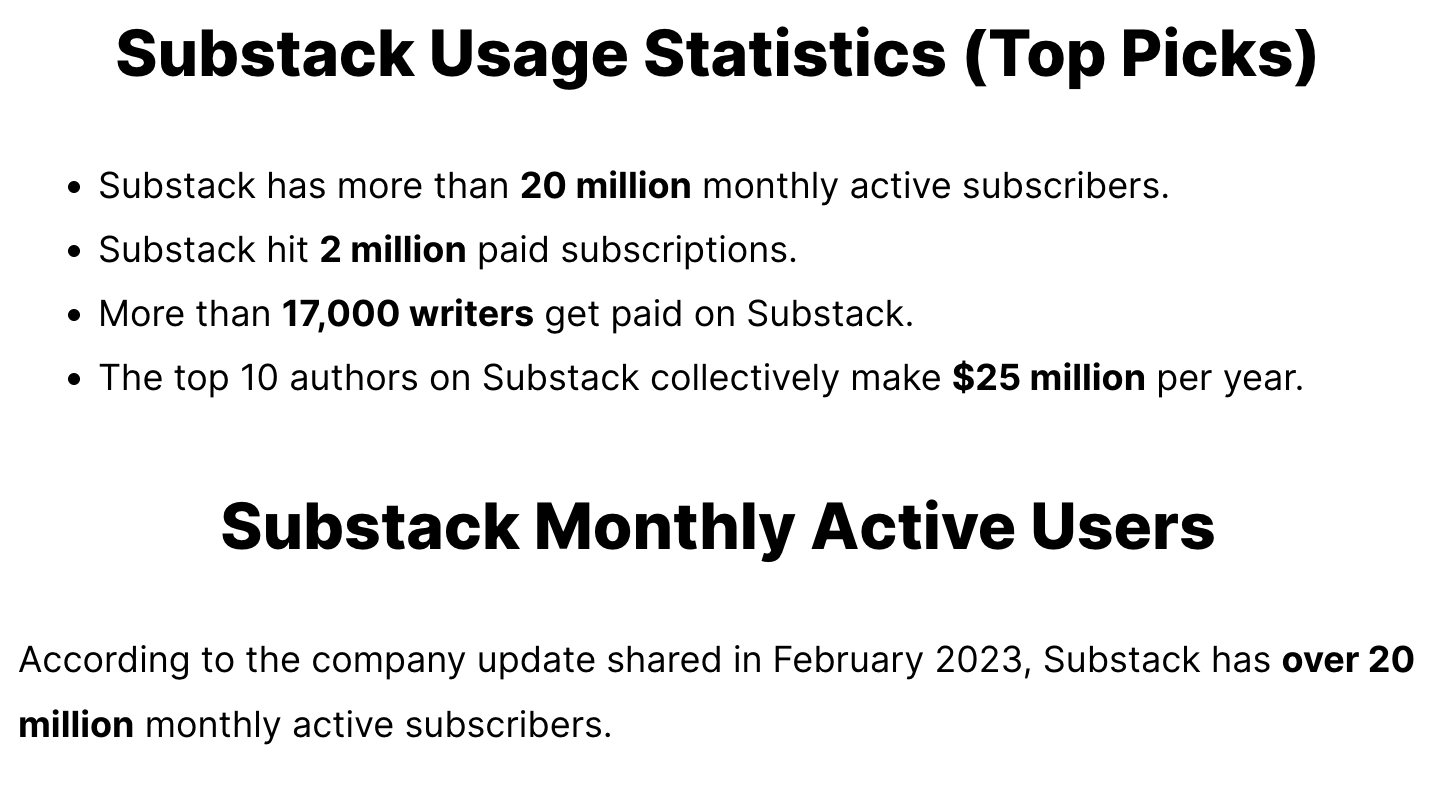
Substack at Scale Company statements and rollups place Substack at more than two million paid subscriptions and tens of millions of active subscriptions in total. Paid subscriptions here represent transactions rather than unique payers, which still signals meaningful scale for the model. Backlinko
6) Economic logic in one page
Acquisition Imported audiences plus internal discovery seed the list.
Activation Welcome sequences and useful first posts set the habit.
Retention Reliable cadence in the inbox raises open-rate momentum.
Monetization Free to paid previews, member perks, and annual plans convert habit into cash.
Reinvestment Revenue funds more time, editing, research, and community features, which in turn raises perceived value.
7) Where the loop can stall
Over-posting without new value lowers open rates and weakens the habit.
If the payment process is too complicated or the subscription tiers are unclear, users will hesitate to upgrade.
8) Strategy for founders and growth leaders
Define the target behavior first, then build rails that make that behavior easy to repeat. Substack aligned three behaviors: writer cadence, reader habit, and paid upgrade timing. Features like Notes and email previews serve those behaviors, not the other way around.
Durable growth followed because the loops rewarded patience and compounding rather than quick spikes.
Still alive in market, and your self-doubt?
Cool. Most great products start right there.
If you survived this dispatch without mental breaks, Anchor sends caffeine.
Recommend this colony log to your fellow survivors.
Really like how this breaks down growth as loops instead of hacks. It captures the long game of trust and compounding better than most takes I’ve seen.
What I really like about this post is that it's not just the usual Substack growth hype - there's references to processes, frameworks, systems, structure and I can tell it's nicely embedded in consumer psychology and marketing techniques.










Really like how this breaks down growth as loops instead of hacks. It captures the long game of trust and compounding better than most takes I’ve seen.
What I really like about this post is that it's not just the usual Substack growth hype - there's references to processes, frameworks, systems, structure and I can tell it's nicely embedded in consumer psychology and marketing techniques.